
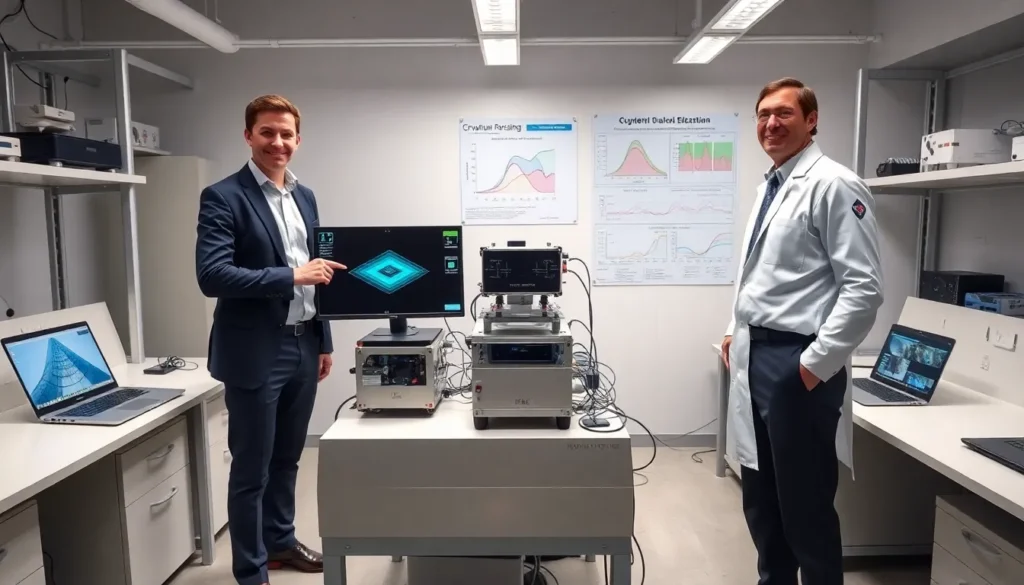
Quantum sensing technology uses quantum properties to measure physical quantities with high precision. The technology exploits superposition and entanglement to detect fields, time, and motion. Researchers build devices that convert tiny signals into readable outputs. The introduction below outlines how the sensors work, the platforms they use, and the main applications. It also covers limits, implementation steps, and likely commercial paths.
Key Takeaways
- Quantum sensing technology leverages superposition and entanglement to convert tiny physical signals into high-precision readouts through repeated state preparation, exposure, and measurement.
- Leading platforms—NV centers, cold atoms/atom interferometers, superconducting circuits, and photonic/optomechanical systems—trade off operating temperature, sensitivity, and deployment complexity for different use cases.
- Prime applications include GPS‑denied navigation and timing, medical and biomagnetic imaging, geophysical and mineral surveying, and nanoscale materials characterization.
- Practical adoption depends on solving decoherence, environmental noise, and scalability challenges by applying shielding, error mitigation, integrated packaging, and hybrid classical–quantum fusion.
- Near‑term commercialization will target portable magnetometers, timing modules, and niche industrial instruments while research focuses on hybrid, error‑resilient designs and standards for wider market uptake.
How Quantum Sensing Works
Quantum States And Measurement
Quantum sensors use quantum states to store information about a quantity. The sensor prepares a state, exposes it to the signal, and then measures the state. The measurement collapses the state and yields a readout that links to the signal. The device often repeats this cycle to improve precision.
Entanglement, Superposition, And Quantum Enhancement
Quantum sensors use superposition to encode multiple values at once. They use entanglement to correlate subsystems and boost sensitivity beyond classical limits. Entanglement can reduce noise in some measurements. Researchers compare entangled and non-entangled protocols to find the best gain for each task.
Common Readout And Interrogation Techniques
Devices use optical, microwave, or electrical interrogation for readout. Optical readout detects fluorescence or phase changes. Microwave readout measures transitions in spin systems. Electrical readout measures current or voltage in circuits. Each technique trades off speed, noise, and technical complexity.
Key Quantum Sensing Platforms
Nitrogen‑Vacancy Centers And Solid‑State Defects
Nitrogen-vacancy (NV) centers in diamond act as stable quantum sensors at room temperature. The NV center senses magnetic and electric fields, temperature, and strain. Engineers integrate NV centers into scanning tips and chip-scale packages. They tune optical and microwave control to maximize signal contrast.
Cold Atoms, Atom Interferometers, And Atomic Clocks
Cold-atom systems use laser cooling and traps to reduce thermal motion. Atom interferometers split and recombine atomic wave packets to measure acceleration and rotation. Atomic clocks lock to atomic transitions to deliver precise time. These platforms deliver high accuracy but often require vacuum and lasers.
Superconducting Circuits And SQUIDs
Superconducting circuits, including SQUIDs, measure tiny magnetic flux changes. They operate at cryogenic temperatures. Engineers use Josephson junctions to read quantum states. The devices provide extreme magnetic sensitivity for material studies and medical imaging.
Photonic And Optomechanical Sensors
Photonic sensors use light phase, intensity, or polarization to sense quantities. Optomechanical sensors couple light to mechanical motion for force and displacement sensing. These systems scale well for fiber-based deployment and can operate at room temperature with compact optics.
Core Applications And Use Cases
Navigation, Timing, And Inertial Sensing
Quantum sensing technology improves inertial measurement units and timing devices. The technology helps in GPS-denied navigation by providing accurate acceleration and rotation data. Atomic clocks and atom interferometers deliver stable time and precise inertial references for vehicles and infrastructure.
Medical Imaging And Bio‑Sensing
Quantum sensors enhance magnetic sensing for brain and heart imaging. SQUIDs and NV centers can detect weak biomagnetic signals. Photonic sensors can sense small refractive index changes in bioassays. Clinicians and researchers use the sensors to detect early signs of disease and to map neural activity.
Geophysical Surveying, Oil & Gas, And Mineral Exploration
Quantum magnetometers map subsurface magnetic anomalies for mineral and hydrocarbon detection. Field teams use portable sensors for rapid surveys. The sensors reduce survey time and improve detection of small ore bodies or buried structures.
Materials Characterization, Quantum Microscopy, And Security
Quantum sensing technology enables high-resolution magnetic and electric imaging of materials. NV centers and scanning probe systems reveal nanoscale defects and domain structures. Security teams use sensitive detectors for threat detection and verification of critical assets.
Advantages, Challenges, And Practical Limits
Sensitivity, Resolution, And Quantum Advantage
Quantum sensors often outperform classical sensors in sensitivity and resolution. The sensors can reach or approach quantum limits of measurement. The advantage depends on the specific task and environmental control. Developers compare quantum and classical solutions to justify adoption.
Environmental Sensitivity, Noise Sources, And Decoherence
Quantum systems suffer from decoherence due to interactions with the environment. Thermal noise, magnetic fluctuations, and vibration degrade performance. Engineers apply shielding, control fields, and error suppression to reduce noise. The solutions add complexity and cost.
Scalability, Cost, And Engineering Challenges
Scaling quantum sensors to mass markets requires cheaper materials and simpler control. Cryogenics and precise lasers increase system cost and size. Packaging and ruggedization pose engineering challenges for field use. Teams work to replace complex subsystems with integrated electronics and compact optics.
Implementation Considerations For Developers And Researchers
Hardware, Cryogenics, And Packaging Requirements
Developers select hardware based on operating temperature and target sensitivity. Some platforms work at room temperature: others need cryogenic cooling. Packaging must protect the quantum state while allowing necessary access for interrogation. The design must balance size, power, and thermal control.
Calibration, Error Mitigation, And Data Processing
Teams calibrate sensors with reference standards and cross-checks. They apply error mitigation like dynamical decoupling and averaging. Data processing filters and extracts signals from noisy traces. Machine learning can assist in pattern recognition and drift correction.
Integration With Classical Sensors And Systems
Integration pairs quantum sensors with GPS, inertial sensors, and telemetry. The hybrid system uses classical sensors for coarse references and quantum sensors for fine measurements. Engineers design interfaces, time synchronization, and data fusion algorithms to merge outputs.
Future Trends And Commercialization Roadmap
Near‑Term Commercial Products And Early Markets
Manufacturers will release portable magnetometers, timing modules, and lab instruments first. Industries such as defense, oil and gas, and medical imaging will lead early adoption. Startups focus on niche applications where quantum sensing technology yields clear performance gains.
Research Directions: Hybrid Sensors And Error‑Resilient Designs
Researchers build hybrid sensors that combine atomic and solid-state elements. They pursue error-resilient designs that extend coherence and reduce control needs. The aim is to cut size, weight, and power while keeping or improving sensitivity.
Standards, Regulation, And Adoption Challenges
Standards bodies will develop test methods and performance metrics for quantum sensors. Regulators will assess safety and operational limits for field use. Adoption will depend on demonstrable value, interoperability, and reduced system cost.